Welcome to the Secretary of the Commonwealth’s
KIDS’ ZONE
Welcome to the Secretary of the Commonwealth’s
KIDS’ ZONE
"I shall enter on no encomium upon Massachusetts; she needs none.
There she is. Behold her, and judge for yourselves. There is her history;
the world knows it by heart. The past, at least, is secure. There is Boston
and Concord and Lexington and Bunker Hill; and there they will remain
forever."
- Daniel Webster, 1830
Massachusetts takes its name from the Massachusett tribe of Native Americans, who lived in the Great Blue Hill region, south of Boston. The Indian term, roughly translated as, “at or about the Great Hill”.
There are, however, a number of interpretations of the exact meaning of the word. The Jesuit missionary Father Rasles thought that it came from the word Messatossec, “Great-Hills-Mouth”: “mess” (mass) meaning “great”; “atsco” (as chu or wad chu) meaning “hill”; and sec (sac or saco) meaning “mouth”. The Reverend John Cotton used another variation: “mos” and “wetuset”, meaning “Indian arrowhead”, descriptive of the Native Americans’ hill home. Another explanation is that the word comes from “massa” meaning “great” and “wachusett”, “mountain-place”.
Massachusetts, like Pennsylvania, Virginia, and Kentucky, is called a “Commonwealth”. Commonwealths are states, but the reverse is not true. Legally, Massachusetts is a commonwealth because the term is contained in the Constitution. In the era leading to 1780, when the state Constitution was ratified, a popular term for a whole body of people constituting a nation or state was the word “Commonwealth”. This term was the preferred usage of some political writers. There also may have been some anti-monarchic sentiment in using the word “Commonwealth”. The name, which in the eighteenth century was used to mean “republic”, can be traced to the second draft of the state Constitution, written by John Adams and accepted by the people in 1780. In this second draft, Part Two of the Constitution, under the heading “Frame of Government”, states, “that the people…form themselves into a free, sovereign, and independent body politic, or state by the name of The Commonwealth of Massachusetts”. The people had overwhelmingly rejected the first draft of the Constitution in 1778, and in that draft and all acts and resolves up to the time between 1776 and 1780, the name “State of Massachusetts Bay” had been used. Thereafter, John Adams utilized the term “Commonwealth” when framing the Massachusetts Constitution. In his “Life and Works”, Adams, wrote: “There is, however, a peculiar sense in which the words republic, commonwealth, popular state, are used by English and French writers, who mean by them a democracy, a government in one centre, and that centre a single assembly, chosen at stated periods by the people and invested with the whole sovereignty, the whole legislative, executive and judicial power to be included in a body or by committees as they shall think proper”.
The Coat of Arms, according to legislative enactment, consist of “a shield having a blue field or surface with an Indian thereon, dressed in a shirt and moccasins, holding in his right hand a bow, and in his left hand an arrow, point downward, all of gold; and, in the upper corner of the field, above his right arm, a silver star with five points. The crest is a wreath of blue and gold, on which in gold is a right arm, bent at the elbow, clothed and ruffled, with the hand grasping a broadsword”. The shield’s shape is called “Plantagenet”; the Native American model used was of the Algonquin nation; the arrow points downward to indicate that the Indian is peaceful; and the star indicates that Massachusetts was one of the original thirteen states; it was sixth. The sword illustrates the Latin motto that is written in gold on a blue ribbon around the bottom of the shield: “Ense petit placidam sub libertate quietem”. This is the second of two lines written about 1659 by Algernon Sydney, English soldier and politician, in the Book of Mottoes in the King’s Library in Copenhagen, Denmark. It was adopted in 1775 by the Provincial Congress and means, “By the sword we seek peace, but peace only under liberty”.
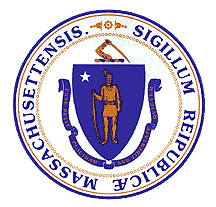
The State Seal, adopted by Governor John Hancock and the Council on December 13, 1780 and made official by the General Court on June 4, 1885, is circular and bears a representation of the arms of the Commonwealth encircled with the words, “Sigillum Reipublicae Massachusettensis” (Seal of the Republic of Massachusetts). The final form of the seal was determined by a statewide contest.
The State Flag is white, bearing on both sides a representation of the coat of arms like the state seal (except that the five-pointed star is white instead of silver). It was approved for the Commonwealth in its final form on July 3, 1971; before that, the obverse side depicted a green pine tree.
The Mayflower (Epigaea repens), also commonly known as the ground laurel or trailing arbutus, has ovate hairy leaves and fragrant, pink or white, spring-blooming flowers with five petals. It grows in woods, preferring sandy or rocky soil, under or near evergreens. It was adopted as the official flower of the Commonwealth by the General Court on May 1, 1918. Unfortunately, since 1925 it has been on the endangered list.
The American Elm (Ulmus Americana) was adopted as the state tree on March 21, 1941, to commemorate the fact that General George Washington took command of the Continental Army beneath one on Cambridge Common in 1775. It is a large tree with gray flaky bark. When growing in the forest it often attains a height of 120 feet, but in the open it is wide-spreading and of lesser height. The leaves are oval, and dark green, turning to a clear yellow in the autumn. The American Elm, like most elms, has been severely afflicted by Elm Disease.
The BLACK-CAPPED Chickadee (Penthestes atricapillus) was adopted as the state bird by the Massachusetts Legislature on March 21, 1941. It is also known as the titmouse, tomtit, and the dickybird, and it is one of the most familiar of the North American birds. It is from four to five inches in size, its tail accounting for nearly half its length. The general coloring is ashy-grey, the back having a brownish tinge; the crown, nape, chin, and throat are black, and the cheeks white. It nests in a stump, tree, or fence post close to the ground, and broods twice a year. It is a cheerful bird and has a pleasing call: “Chick-adee-dee-dee”.
Cranberry juice was named the beverage of the Commonwealth on May 4, 1970. This was a tribute to the great Massachusetts cranberry industry.
The Morgan horse (Equus cabullus morganensis), descended from a little bay stallion born in West Springfield, MA, in 1789, who could outrun and outwork any horse brought against him. Named “Figure” by his owner, schoolteacher and singing master Justin Morgan, in later years he was known by his master’s own name, “Justin Morgan”. The gallant little horse died in Vermont in 1821 at the age of 32; the sturdy breed bearing his name was adopted as the state horse on May 14, 1970.
Most common in the state is the Two-Spotted Lady Beetle (Adalia bipunctata). Its head is black with pale yellowish margins; elytra reddish, with two black spots. The idea originated with a second-grade class in the Town of Franklin and the Ladybug became the state insect on April 17, 1974.
The Cod (Gadus morrhua). A soft-finned fish, usually 10-20 lbs. General coloring is olive grey with lateral lines paler than rest of body tint. Indians and Pilgrims used them as common food and fertilizer. A sculpture of a cod hangs in the House of Representatives as a tribute to this useful aquatic creature. For over 200 years, the emblem of the cod has remained a symbol of the Commonwealth’s economic beginnings, as the fishing industry provided the Puritans with food, fertilizer, and revenue for trade. The Cod was approved as the state fish as of May 2, 1974.
The Boston Terrier (Canis familiaris bostenensis), the first purebred dog developed in America (1869), is a cross between an English bulldog and an English terrier. It was recognized by the Legislature on May 14, 1979 as the state dog or dog emblem of the Commonwealth.
Rhodonite is the most beautiful gem material found in the state. It varies in hue from a light pink to a deep rose or reddish pink and is associated with black manganese. It was adopted in 1979 as the gem or gem emblem of the Commonwealth.
The Right Whale (Eubalaena galcialis) got its namesake from whalers for being the “right” whale to hunt due to slow speed, surface feeding habits, buoyancy, and high profits in blubber products. By the late 1800’s it was critically endangered and became illegal to hunt. The RIGHT WHALE became the marine mammal or marine mammal emblem of the Commonwealth in 1980.
The dinosaur tracks in Massachusetts, which were made over 200 million years ago. In Granby, the prints of a theropod dinosaur fifty feet in length from head to tail (the first record of a theropod of such magnitude), were found. They were made the state fossil in May 23, 1980.
Although the commonwealth is not overly blessed with mineral resources, Massachusetts is one of the few locations in the world where BAbingtonite is found. This jet black material with a brilliant submetallic luster is the finest quality bAbingtonite found in America. The Legislature made this mineral the ‘state mineral’ of the Commonwealth on April 24, 1981.
"All Hail to Massachusetts", words and music by Arthur Marsh, was designated by an act of the Legislature on July 6, 1981 (informally "official song" since September 1966.)
"Massachusetts", words and music by Arlo Guthrie, was adopted by the Legislature on July 6, 1981 as the folk song of the Commonwealth.
On September 24, 1981, the General Court designated "The Blue Hills of Massachusetts" by Katherine E. Mullen of Barre as the official state poem of the Commonwealth.
The Roxbury Puddingstone, sometimes called Roxbury Conglomerate, became the state rock or rock emblem of the Commonwealth on May 23, 1983.
Plymouth Rock, although the Pilgrims did not actually land on it, has historical significance that led the Legislature to commemorate it on May 23, 1983.
Dighton Rock was made the explorer rock of the Commonwealth on May 23, 1983.
Granite was made the building and monument stone of the Commonwealth on May 23, 1983. The last Ice Age did leave Massachusetts with exceptionally fine samples of this rock; granite from Quincy was used to build the Washington Monument.
DEBORAH SAMSON fought in the War of Independence under the name of Robert Shurtleff (also spelled “Shurtliff” and “Shurtlieff”) with courage, determination, and outstanding service, and rendered a unique contribution as a woman to American independence. Her masquerade remained undiscovered until she was wounded in battle. In later years, she travelled extensively, lecturing about her experiences, and a grateful nation gave her the first military pension ever awarded to a woman. The Governor annually issues a proclamation setting apart May 23 as an anniversary day to appropriately observe her enlistment in the Continental Army. The Legislature recognized her heroism on July 22, 1983. (Note: While “Sampson” is the generally used spelling, “Samson” has also been said to be correct and is the spelling used in the statute).
The song "The Road to Boston", whose composer is unknown, has been the official ceremonial march of the Commonwealth since November 13, 1985.
The school children of Massachusetts petitioned for the corn muffin, a staple of New England cooking, and the Legislature made it official on May 27, 1986.
The New England Neptune (Neptuna lyrata decemcostata) was made the Shell of the Commonwealth on June 26, 1987.
The Tabby cat (Felis familiaris) was made the official state cat on July 11, 1988, in response to the wishes of the school children of Massachusetts.
"Massachusetts (Because of You Our Land is Free)", words and music by Bernard Davidson, was made official on October 23, 1989.
Square dancing became the official folk dance on April 8, 1990.
The Paxton Soil Series was adopted by the Legislature on July 10, 1990.
The Vietnam War Memorial was approved on December 11, 1990 and is located in the City of Worcester, Massachusetts.
On December 18, 1990, the Legislature decided that the people of the Commonwealth would be designated as Bay Staters.
The Wild Turkey (Meleagris gallopavo), which was eaten at the first Thanksgiving, was designated the state game bird of the Commonwealth on December 23, 1991.
The Southwest Asia War Memorial was approved on June 2, 1993.
Cultivated plants and the colloquial names for them change over the centuries, but on June 23, 1993 the legislature finally determined that the NAVY BEAN had been the original bean in the famous and venerable Boston Baked Bean recipe.
On January 13, 1994, the Schooner Ernestina was designated the official vessel of the Commonwealth, with New Bedford as its official homeport.
A fifth-grade class on the North Shore adopted the cause of making the CRANBERRY (Vaccinium macrocarpon) the official berry of the state. Their two years of lobbying, petitions, and hearings were finally rewarded on July 11, 1994.
Johnny Appleseed was designated the official folk hero of the Commonwealth on August 2, 1996. Appleseed was born John Chapman on September 26, 1774 in Leominster, MA and lived until 1845. An American pioneer and hero of folklore, he was nicknamed Johnny Appleseed due to his planting of apple trees from New England to the Ohio River Valley.
The Boston Cream Pie, created in the 19th century, was chosen as the Commonwealth dessert on December 12, 1996. A civics class from Norton High School sponsored the bill. The pie beat out other candidates, including the toll house cookie and Indian pudding.
The chocolate chip cookie was designated the official cookie of the Commonwealth on July 9, 1997. A third grade class from Somerset proposed the bill to honor the cookie invented in 1930 at the Toll House Restaurant in Whitman.
The song "The Great State of Massachusetts", words by George A. Wells, and music by J. Earl Bley, was designated the state glee club song of the Commonwealth on November 24, 1997.
On October 1, 1998, "SAY HELLO TO SOMEONE FROM Massachusetts" by Lenny Gomulka was approved as the official polka of the Commonwealth.
In recognition of veterans who served in WWI, the Orange Peace Statue shall be the official peace statue of the Commonwealth as of February 25, 2000.
Located in the Shipyard Park of the Charlestown Navy Yard, the State Korean War Memorial was approved on April 7, 2000 for the Commonwealth.
On November 22, 2000 the words and music of "Ode to Massachusetts" by Joseph Falzone was approved as the official ode of the Commonwealth.
The state MIA/POW memorial is located in the town of Bourne at the Massachusetts National Cemetery and was approved on July 3, 2002 for the Commonwealth.
Make Way for Ducklings by Robert McCloskey was designated the official children's book of the Commonwealth on January 1, 2003. The third grade class at the Dean S. Luce Elementary School in Canton sponsored the legislation.
On January 1, 2003, author Theodor Geisel, better known as Dr. Seuss, was made the official children's author and illustrator of the Commonwealth.
In 2003 the Boston Creme donut was officially made the Commonwealth donut.
On August 14, 2003, the Bay State Tartan became the official district tartan of the Commonwealth. Registered with the Scottish Tartans Authority, and may be viewed at www.tartansauthority.com/.
On February 21, 2005, blue, green and cranberry became the official colors of the Commonwealth.
On February 8, 2006, musician Henry St. Clair Fredericks, better known as Taj Mahal, was approved as the official blues artist of the Commonwealth.
On August 8, 2006, basketball became the official state sport. Invented in 1891 by Springfield, Massachusetts teacher Dr. James Naismith.
On November 16, 2006, Benjamin Franklin became the official inventor of the Commonwealth.
The Garter Snake became the official reptile of the Commonwealth on January 3, 2007.
On February 21, 2008, Norman Rockwell became the official artist of the Commonwealth.
On August 4, 2008, Rolling Rock located in the city of Fall River became the state glacial rock of the Commonwealth.
On August 11, 2011, Salem became the birthplace of the National Guard for the Commonwealth.
On July 31, 2014 MS. G OF THE Massachusetts AUDUBON SOCIETY was named the Official Groundhog of the Commonwealth and shall be utilized as a way to educate elementary school children on the importance of meteorology.
On July 31, 2014 VOLLEYBALL was named the Official Recreational and Team Sport of the Commonwealth.
On April 29, 2022 Podokesaurus Holyokensis was named the Official Dinosaur of the Commonwealth.