
Peter Salem a free African American man, was one of thousands of Black soldiers from Massachusetts who fought in the Revolutionary War. Salem served in the Continental Army for five years and fought in several major battles. He died in Framingham in 1816.
From the beginning, British colonies in North America placed heavy restrictions on Black men and military service. Amid fears of triggering a slave revolt, most colonies prohibited Black men from participating in any form of military training or service. As a result, Massachusetts – with a small population of enslaved men and women – was one of the few colonies in British North America to allow African Americans to serve in militia units.
Over the course of the eighteenth century, Black soldiers from Massachusetts fought alongside white soldiers in many famous campaigns, including the Siege of Louisbourg in 1745 and the capture of Quebec in 1759.
For enslaved and free Black men in Massachusetts, the American Revolution proved to be a watershed moment. Indeed, African American men played a prominent role in the struggle for independence from the very first moment of conflict, when Prince Estabrook, a Black militiaman, was wounded on Lexington Green.
Over the course of the eight-year war, Black soldiers fought in every important battle and campaign, including Bunker Hill, Saratoga, and Yorktown. By the end of the war, more than 2,000 men of color from Massachusetts had fought, bled, and died to secure the nation’s independence. Significantly, they did so side-by-side with white soldiers in fully integrated regiments – the last such units in the United States military until 1953.
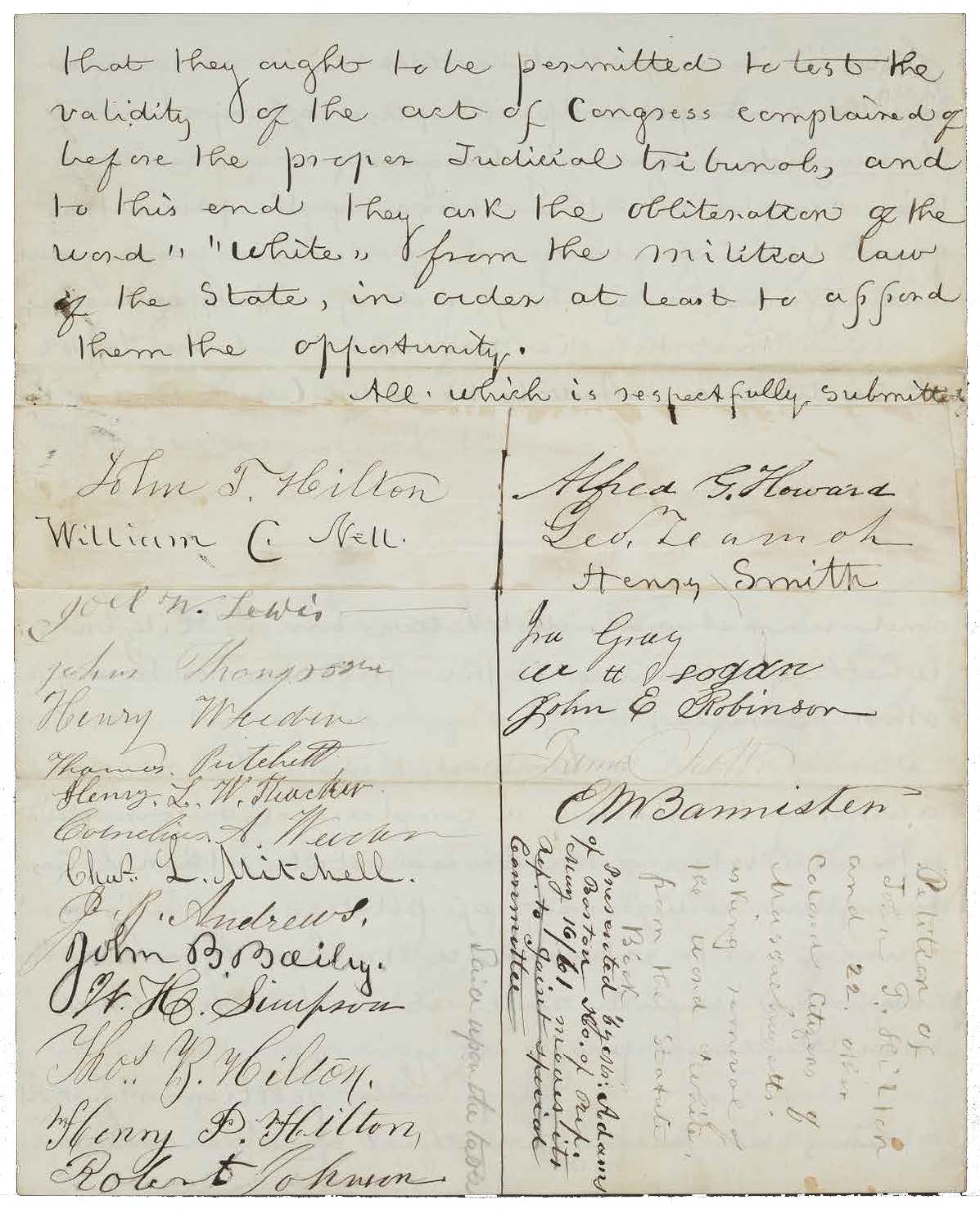
After the Revolution, Massachusetts joined a new nation struggling to reconcile the rights of people of color with its racial prejudices and institutions. In 1792, the federal government adopted “An Act to Regulate the Militia,” which explicitly forbade African Americans from enrolling in the state’s militia or serving in the armed forces.
For the next seventy years, African Americans in Massachusetts were forced to fight for the right to once again resume their place in the ranks of the state’s militia.
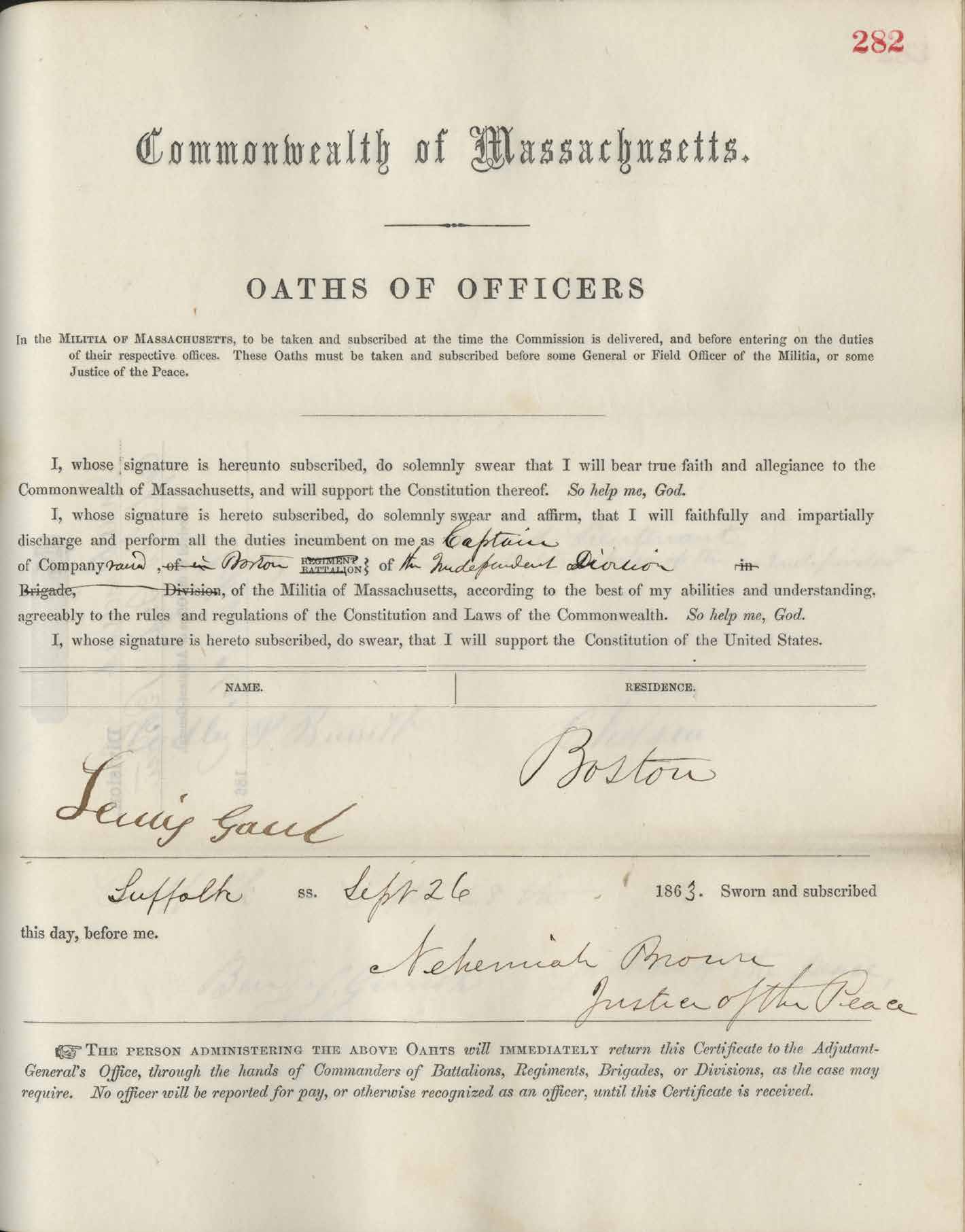
In 1863, Lewis Gaul . . .
In 1863, Lewis Gaul was formally commissioned as captain of the first Black militia company in Massachusetts. Source: enlistment roll, 14th Unattached Company, 1863.
- Massachusetts Archives