
Thanksgiving Mysteries
Where was the first Thanksgiving?
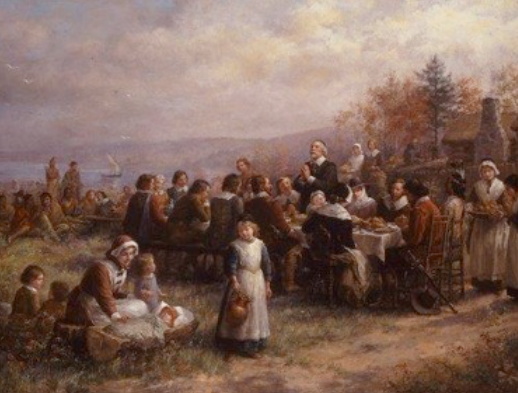 Every school child used to learn that the event happened in Plymouth, Massachusetts in 1621. After surviving a harsh winter in the new world, a sturdy band of Pilgrims met with their Wampanoag neighbors to celebrate the harvest. It was assumed that they feasted on turkey, with some of the trimmings, and began a tradition that continues to the present day.
In recent decades that version has been challenged by historical research and competing claims about the origins of Thanksgiving.
The Berkeley Thanksgiving
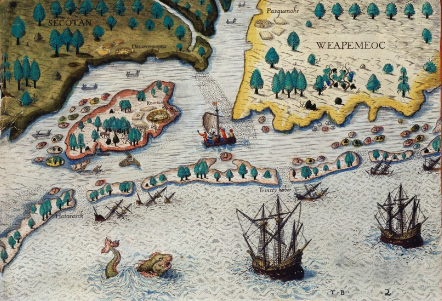 Some argue that the first thanksgiving occurred in Virginia. In 1619 a group of settlers sailed up the James River with instructions from the London Company that “the day of our ship’s arrival...shall be yearly and perpetually kept holy as a day of Thanksgiving to Almighty God.” Debarking at a tract called “Berkeley Hundred” they held a Thanksgiving service on December 4th - two years before the Pilgrim celebration.
Although interesting to historians, the Berkeley thanksgiving was largely forgotten until the twentieth century. It did not include a turkey dinner (shown on some travel brochures) and did not start a holiday tradition.
Plymouth, 1621
 What about the Pilgrim "thanksgiving?"
At their harvest feast in 1621 the Pilgrims did not know they were starting a holiday. For that matter they did not know they were “Pilgrims.” That label became more common later.
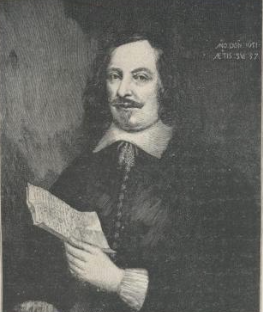
Edward Winslow wrote a brief account of events. After English hunters went “fowling,” for game birds, Massasoit and ninety men joined them for three days of games and feasting. Native hunters contributed five deer. Writing nearly 400 years before the Internet, Winslow’s account did not create a sensation.
Pilgrims and Puritans
 The question remains, where was the first Thanksgiving?
Like Rome, the Thanksgiving tradition was not built in a day but did develop in colonial Massachusetts. Two like-minded groups played a role.
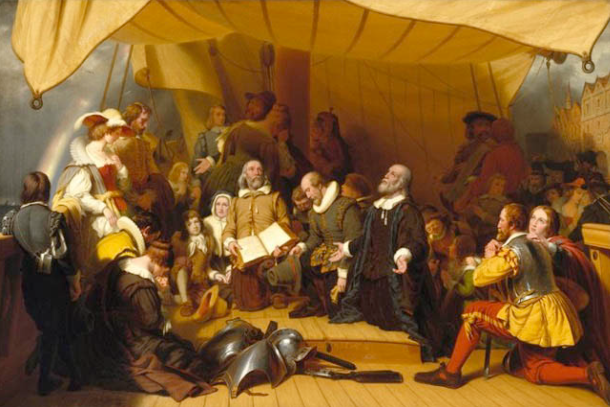
In 1620 separatists founded the Plymouth Colony, making a complete break with the Church of England. Ten years later “Puritans” established the Massachusetts Bay Colony, In theory, they hoped to “purify” the Anglican Church – from a distance of 3,000 miles. Both groups shared Calvinist beliefs including an aversion to holidays, in part because they began as “holy days” in the Catholic and Anglican churches.
Banning Christmas
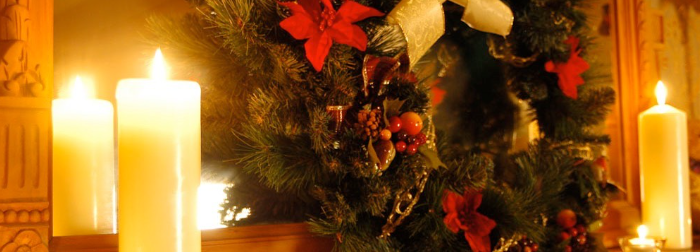 Both colonies banned the celebration of
Christmas.
Both colonies banned the celebration of
Christmas.
The date of December 25th did not appear in the Bible and the day was marked by “mad Mirth… long Eating… hard Drinking... and rude Reveling.” Although deeply religious, the Massachusetts Bay Puritans observed secular holidays including Election Day, and Harvard Commencement day. Still, it may have seemed that something was missing, a holiday in the late fall, early winter period.
Fasting and Feasting
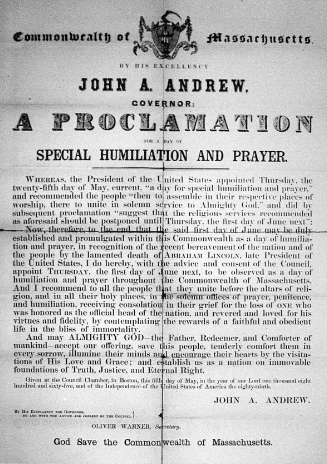 During the Civil War Massachusetts Governor John Albion Andrew declared a day of fasting “Humiliation and Prayer” in April 1861. He also proclaimed a “Day of Thanksgiving and Praise” later that year. The language would be familiar to Puritan settlers two hundred years earlier.
When things went wrong, or a difficult challenge loomed, Pilgrims and Puritans declared a day of fasting. With good fortune, they held a day of thanksgiving. From a modern viewpoint the days might seem similar, with long hours in the meetinghouse, followed by a light meal on fast days, and a more celebratory meal on days of thanksgiving. The holiday evolved from this tradition.
An Early Thanksgiving
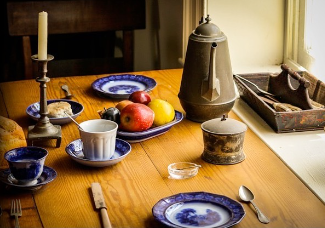 In his wonderful book Thanksgiving, James W. Baker provides an account of an actual Plymouth colony Thanksgiving in the town of Scituate in 1636. It begins with prayers, psalms, and the “Word taught.” And where did this event occur?
In ye Meetinghouse, beginning some halfe an houre before nine & continued until after twelve a clocke, ye day being very cold...Then makeing merry to the creatures, the poorer sort beeing invited of the richer.
Why is Thanksgiving on Thursday?
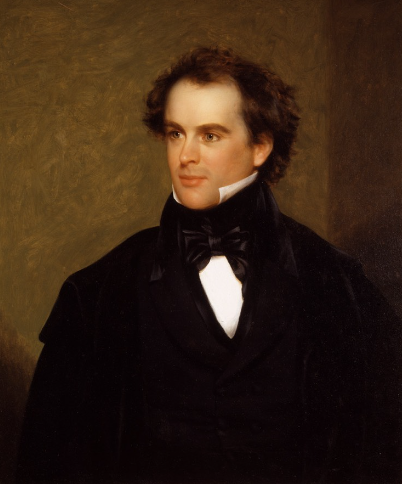 Sunday was the Sabbath and off limits for days of Thanksgiving. After a long day at the meetinghouse, an early weekday Thanksgiving might have been too much since it also required hours of prayer, psalms and lectures. Thursday was market day in Plymouth and the Massachusetts Bay colony. It was also “lecture day” (described by Nathaniel Hawthorne) when ministers preached their “great and Thursday lecture.” Because it was a special day Thursday was often selected for Thanksgiving.
Why is turkey the favorite Thanksgiving dish?
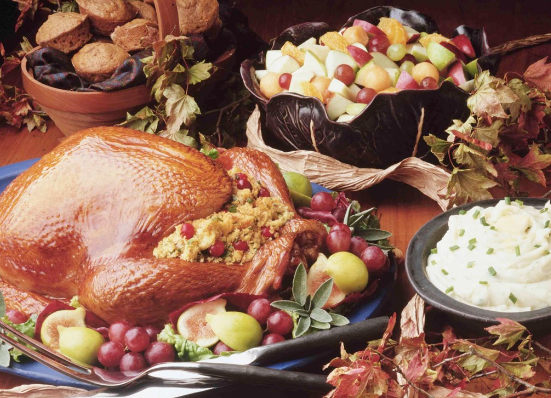 We cannot say for sure but there is at least one clue. Turkey is not native to England but was introduced during the age of exploration. Because it was rare, turkey was available to the upper classes at first. Wild turkey was more abundant in Massachusetts but may have retained its image as a special occasion dish. Early thanksgivings also included other menu items but turkey gained pride of place over time.
Into the Nineteenth Century
 Thanksgiving spread from Massachusetts to other northern colonies as Puritans and their descendants moved west.
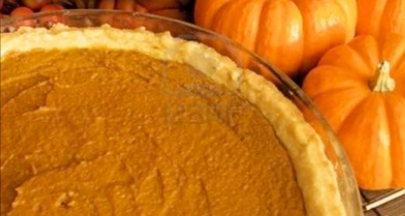
By the nineteenth century the holiday was recognizable, with sermons or speeches in the morning (including abolitionist themes by mid-century) and a family dinner often featuring turkey and cranberry sauce. (With sugar more easily accessible the tart cranberry was tamed.) In 1621 there were no mashed potatoes or apple pies. Those foods had not been introduced in Massachusetts. Probably there were native pumpkin dishes (and, yes, cranberries.) Two hundred years later apple and pumpkin pie were thanksgiving staples.
Weighing in on Thanksgiving 1862
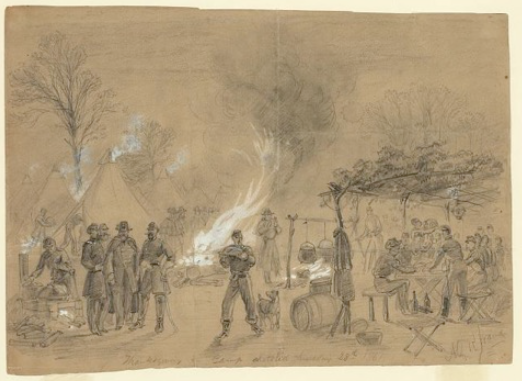 During the Civil War, efforts were made to supply Thanksgiving dinners to soldiers in the field. Major Wilder Dwight of the Second Regiment Massachusetts Volunteer Infantry reported on the regiment’s Thanksgiving menu. The men were served 95 turkeys weighing 997 ½ pounds, 76 geese weighing 666 pounds, 73 chickens weighing 165 pounds and 95 servings of plum pudding weighing 1174 pounds.
A National Holiday
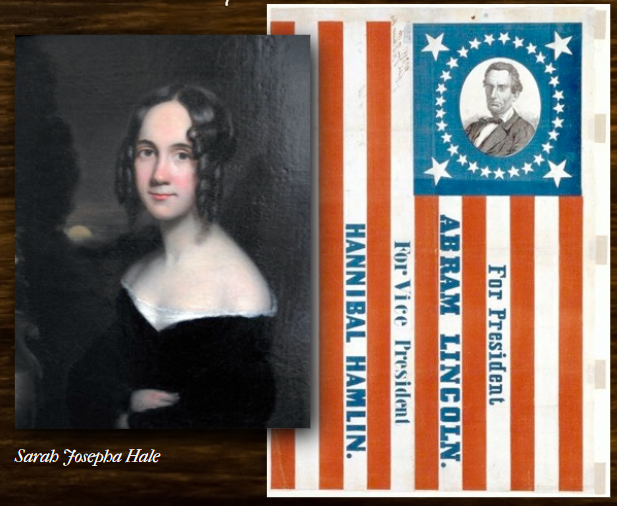 As with many holidays the arrival of mass media helped to spread and standardize practices. Sarah Josepha Hale, editor of Godey’s Ladies Book (and author of “Mary Had a Little Lamb”) campaigned to make Thanksgiving a national holiday. President Abraham Lincoln responded by declaring the fourth Thursday in November a national thanksgiving. It has been celebrated each year since.
Rediscovering the Pilgrims
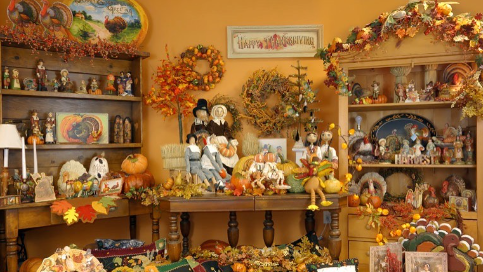 By late in the century nearly every element of a modern Thanksgiving was in place (including football games with somewhat different rules.) Only one thing was missing - the Pilgrims.
Scholars rediscovered accounts of the Pilgrim/ Wampanoag festival of 1621 and some pronounced it the “First Thanksgiving.” Some also cited the 1623 Plymouth feast that was called a “thanksgiving.”
As a colonial revival mood took hold - emphasizing charm and quaintness over historical accuracy - the Pilgrim story fit right in. By the twentieth century the familiar (but inaccurate) image of Pilgrims with black hats and large buckles was a gift shop/greeting card staple.
Reassessing a Holiday
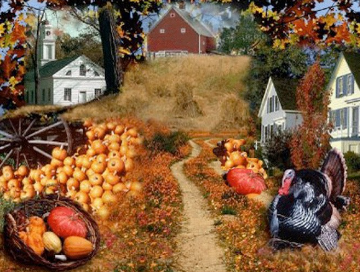 By the 1960’s a more critical look at American history took hold. The Civil Rights movement and Vietnam War protests pointed to flaws in the American story. In 1970 some Native Americans declared Thanksgiving a “Day of Mourning,’ the beginning of attempts to suppress their culture. One effect was to focus on the culture of native people and their own thanksgiving traditions. Among the Narragansett there are thirteen thanksgivings, one for each of the moons.
"Where was the first Thanksgiving?"
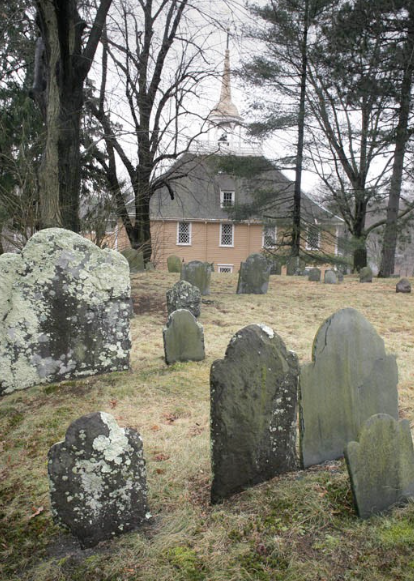 "I began an op-ed article with that question in the Patriot Ledger on Thanksgiving Day, 1993. Although I have continued learning about the Pilgrims and Puritans since, I will conclude as I did then."
“Thanksgiving as we know it was a blend of ancient religious and civil traditions with the food and customs of colonial New England. The story of its Pilgrim origins may have been embellished a bit by sentimental Victorians. However, its roots must surely be traced to Plymouth and the other towns of Old New England.”
~ Stephen Kenney, Director, Commonwealth Museum
Share Thanksgiving Memories
 If parents or teachers would like to share Thanksgiving themed photos we will post them on the Commonwealth Museum facebook page.
Send to commonwealthmuseum@sec.state.ma.us
If parents or teachers would like to share Thanksgiving themed photos we will post them on the Commonwealth Museum facebook page.
Send to commonwealthmuseum@sec.state.ma.us
A special treat (literally!)
Stokes, Lori with Sarah Stewart and Chris Peterson. The Pleasure of the Taste, Boston, Massachusetts: The Partnership of Historic Bostons, 2015. These 17th-century recipes provide an authentic taste of early Massachusetts. Available through www.historicbostons.org
Learn more!
Baker, James W. Thanksgiving: the Biography of an American Holiday, Durham, New Hampshire: University of New Hampshire Press, 2009.
For young readers
Grace, Catherine O’Neill and Bruchac, Margaret M, with Plimoth Plantation, 1621 A New Look at Thanksgiving, Washington, D.C.: National Geographic, 2004.
Special thanks to the Peabody Essex Museum. www.pem.org